
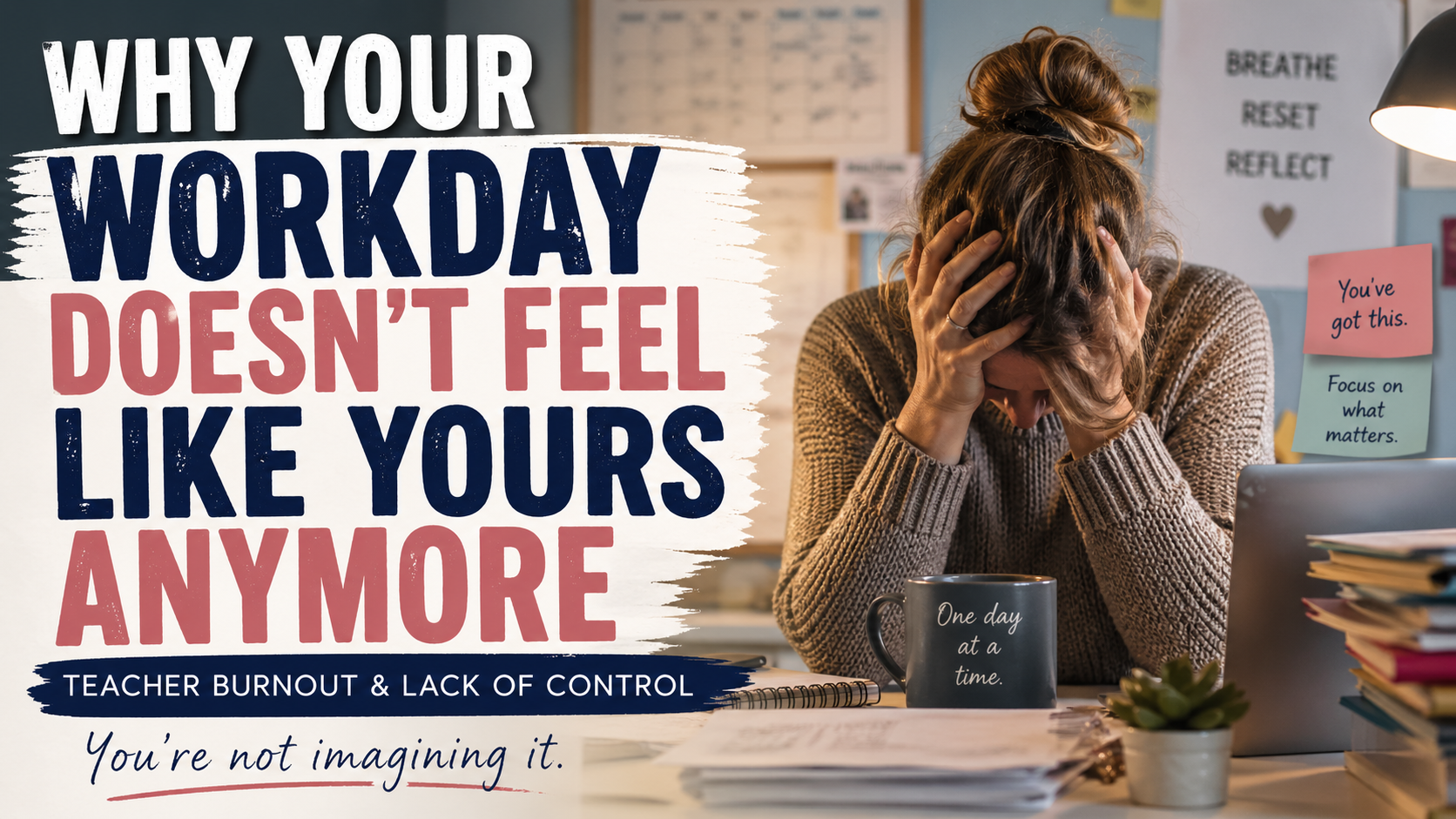
Why Your Workday Doesn’t Feel Like Yours Anymore
There’s a moment most teachers know, even if we don’t always say it out loud.
You walk into school with a plan. Not a perfect plan, just something solid enough to get you through the day. Lessons ready. Timing mapped out. You know what needs doing.
And within about twenty minutes, it’s gone.
An email lands. A student situation unfolds. Someone needs something “quickly.” And just like that, you’re no longer teaching – you’re just reacting your way through the day.
If you’ve been feeling that shift, that quiet loss of control, you’re not imagining it.

The day that slips away from you
It’s not usually one dramatic moment.
It’s the slow unraveling of what you thought the day would be.
You start with a clear intention. Maybe it’s a lesson you actually felt good about. Maybe it’s a class you’ve been trying to get back on track. And then something pulls you sideways. Then something else. Then another thing you didn’t plan for.
By the end of the day, you realise you didn’t really teach the way you wanted to. You just managed.
As a teacher, you know that teaching isn’t just about getting through content. A large part of it, is the way you deliver it, the rhythm of the lesson, the connection you build in those in-between moments. When that gets disrupted over and over, it chips away at your sense of competence.
Picture this.
You’re standing at the front of the room, halfway through explaining something, and your brain is already juggling three other things. Maybe its an email you haven’t answered. Or a conversation you need to have. Perhaps its a form you forgot to submit. You keep going, but you’re not fully there.
A few small shifts that can help:
- Protect the first 10 minutes of your lesson like it actually matters, because it does
- Let one thing go unfinished instead of trying to carry everything at once
- Remind yourself that a steady lesson beats a perfect one

It’s not one thing – it’s everything together
People love to ask, “What’s causing teacher burnout?”
As if it’s one clear answer.
It’s not.
It’s the constant interruptions. The emails. The tracking. The extra layers. The “just one more thing” that never really feels like just one thing.
None of it feels huge on its own. That’s the tricky part.
But together, it creates this low-level friction that follows you all day. You’re constantly adjusting, switching, responding. There’s no clean run at anything anymore.
And over time, that wears you down in a way that’s hard to explain.
It matters because your brain never really gets to settle. You don’t get that feeling of being fully in something and completing it. You’re always slightly pulled in another direction.
Picture this.
You sit down at your desk to plan. You open your laptop. Within minutes, you’ve checked emails, responded to something urgent, been interrupted by a colleague, and now you can’t quite remember what you were about to do in the first place. This happens to me all the time!
A few small shifts that can help:
- Batch emails instead of checking them constantly
- Write down your “next task” before interruptions happen
- Accept that you’re working in fragments now, and plan for that reality, at least during some of your day.

When your experience stops feeling valued
This one hits differently if, like me, you’ve been teaching for a while.
You’ve spent years learning what works. Reading the room. Adjusting on the spot. Building relationships that actually make learning possible.
And then you’re asked to follow systems that don’t quite fit that.
Do it this way. Track it like this. Say it like that.
Even when you know there’s a better way.
There’s a quiet frustration in that. Not loud or dramatic, just this steady feeling of being boxed in.
It matters because your professional identity is tied to that experience. When you can’t use it properly, it starts to feel like a waste, even if you’d never say that out loud.
Picture this.
You’re in a lesson and you know exactly what this class needs in that moment. A slightly different approach. A bit of flexibility. But instead, you stick to the required structure, and it falls flat. You walk away knowing it could have gone better.
A few small shifts that can help:
- Give yourself permission to adapt within the structure, even in small ways
- Hold onto your instincts, they’re built from years of real experience
- Mentally separate “what works” from “what’s required” so you don’t lose trust in yourself

The work that follows you home
You finally get a break.
Holidays come around, or even just a weekend, and you think, “This is it. I’ll switch off.”
But the work doesn’t reset.
It waits.
And when you come back, it’s all still there. Plus everything that came in while you were gone that admin were working on. So the break doesn’t really feel like a break. It feels like borrowed time.
For me, that’s exhausting in a different way.
Because rest only works when your brain believes it’s safe to rest. When there’s always something waiting, that switch doesn’t fully turn off.
Picture this.
It’s Sunday afternoon. You’re technically not working. But there’s a quiet weight sitting in the background. You’re already thinking about Monday, about what’s waiting, about how quickly it will all start again.
A few small shifts that can help:
- Choose a clear “cut-off” time for thinking about school and stick to it loosely
- Create a small ritual that signals the end of your workweek
- Remind yourself that not everything needs to be pre-solved before Monday
The quiet question that doesn’t get asked
There’s something a lot of teachers think about but rarely say.
If you follow everything you’re told to do…
and it still doesn’t quite work…
where does that leave you?
Because you did what was asked.
But it doesn’t always match what you know is effective.
That creates a strange kind of tension. You’re responsible, but not fully in control. You’re accountable for outcomes, but not always allowed to work in the way that produces them.
It matters because it slowly shifts how you see yourself in your job. You start second-guessing, not because you lack skill, but because the education system doesn’t quite align with it.
Picture this.
You walk out of a lesson feeling off. Not because you didn’t try, but because you know you weren’t working in a way that actually suits you or your students. And there’s no clear place to put that feeling.
A few small shifts that can help:
- Acknowledge that misalignment instead of brushing it off
- Keep a mental note of what actually works for you, even if you can’t always use it
- Talk to someone who understands, just hearing it out loud can ease the pressure

The shift you can’t unsee
Nothing changed overnight.
That’s the part that makes it harder to pinpoint.
It’s small things, added slowly, until one day you realise your teacher workday isn’t really yours anymore. You start with a plan, but it rarely stays your plan.
You’re adjusting. Reacting. Fitting around systems, emails, expectations.
And when you’ve been doing this for years, that’s the part that wears you down. Not the teaching itself.
It’s the loss of control within it.
You don’t have to make any big decisions today.
You don’t have to figure out your entire future.
But noticing this shift matters. Naming it matters.
Because once you understand why it feels the way it does, you can start to create small pockets where your time feels like yours again.
And that’s where things begin to change. Not all at once. Just enough to let you breathe a little easier in the middle of it all.
N.B. As an Amazon Associate, I earn a small commission on qualifying purchases at no cost to you. Also, some of the images on this website were created with the help of AI.